

Spot Welding Technology: Solving Manufacturing Bottlenecks with Precision and Efficiency
The Core Challenges: Why Legacy Spot Welding Fails
The fundamental principle of resistance spot welding—passing a high current through stacked metals to generate fusing heat at the contact point—belies a process fraught with complexity. Legacy systems, often reliant on simple AC transformers and limited control, falter under today's pressures.
1. The Inconsistency Crisis: Uncontrolled Heat and Material Variance
The Pain: The quality of a spot weld (its nugget size and strength) is exquisitely sensitive to surface condition, electrode wear, material thickness, and coating composition. Traditional welders apply a fixed, high-energy pulse. On coated steels (like galvanized), this burns off the coating inconsistently, leading to poor weld formation and rapid electrode contamination. For advanced materials such as aluminum or ultra-high-strength steel (UHSS), their high electrical conductivity or required narrow heat-affected zones demand precise thermal control that simple systems cannot provide.
The Consequence: The result is unacceptable variance in weld strength. This manifests as "stick welds" (under-welding) that fail under stress or excessive expulsion (over-welding) that damages the material and tools. In critical applications like automotive safety cells or battery connections, this inconsistency poses severe safety risks, drives up scrap and rework rates, and necessitates costly 100% non-destructive testing.
2. The Productivity Bottleneck: Speed, Access, and Downtime
The Pain: Achieving more welds per minute is a direct path to higher output. Legacy systems are limited by their electrical cycle time and mechanical response. Furthermore, many assemblies feature complex geometries with hard-to-reach flanges. Standard weld guns are often too large, forcing design compromises or slower, manual welding operations.
The Consequence: Production throughput is capped, limiting capacity. The frequent need to stop and dress or change worn electrodes—a byproduct of inconsistent processes—creates unplanned downtime. In high-volume industries, every second of stoppage translates to significant lost revenue and jeopardizes just-in-time production schedules.
3. The Data Black Box: Lack of Process Intelligence and Traceability
The Pain: In an era of Industry 4.0, most traditional spot welders operate as "black boxes." They execute a command but provide no verifiable data on the quality of each weld. Operators might monitor secondary indicators like current or time, but lack direct insight into the key process variable: dynamic electrical resistance.
The Consequence: Quality assurance becomes reactive, based on destructive tear-down tests performed on sample parts. This statistical approach means defective welds can be produced for hours before detection, leading to massive potential recalls. The lack of per-weld data also makes root cause analysis of failures slow and difficult, hindering continuous improvement.
The Advanced Solution: Mid-Frequency Direct Current (MFDC) Spot Welders with Adaptive Control
The response to these challenges is embodied in the modern Mid-Frequency Direct Current (MFDC) spot welding system, integrated with adaptive feedback control and servo-driven weld guns.
The Foundational Principle: Superior Energy Delivery
Unlike traditional AC welders that draw large, fluctuating single-phase power, MFDC welders use a three-phase input rectified and inverted to a stable, high-frequency DC output (typically 1000 Hz). This technological leap offers fundamental advantages:
Higher Electrical Efficiency: MFDC systems draw balanced three-phase power, reducing grid demand by up to 40% for the same welding output.
Precise, Concentrated Energy: The DC output allows for extremely fast and accurate current rise/fall times. The welding current is directed precisely, minimizing magnetic field effects ("magnetic blow") that can deflect the weld nugget in ferrous materials, especially near edges.
The Intelligence Layer: Adaptive Resistance Monitoring
This is the true game-changer. Advanced controllers don't just send a pre-set current for a pre-set time. They continuously monitor the dynamic resistance between the electrodes in real-time (often thousands of times per second). As the materials heat up, melt, and form a nugget, their resistance follows a predictable curve.
How It Solves the Problem: The controller uses this resistance profile as a direct proxy for weld quality. It can be programmed to terminate the weld pulse precisely when the optimal resistance drop is detected (a "constant resistance" strategy), ensuring a perfect nugget every time, regardless of minor variations in surface condition or electrode tip geometry. It can also detect errors—like poor part fit-up or a missing sheet—and abort the weld, preventing damage.
The Mechanical Evolution: Servo-Gun Technology
Replacing traditional pneumatic cylinders with electric servo motors for electrode actuation provides transformative control.
How It Solves the Problem: Servo guns offer programmable, velocity-sensitive approach and forging force. They can apply a precise, multi-stage force profile: a soft touch to seat the parts, followed by the full weld force, and often a maintained "hold" force during cooling to prevent cracking. This is crucial for aluminum and other crack-sensitive alloys. Their compact size also enables access to confined spaces, boosting design flexibility and robot cell efficiency.
Application in Action: Solving Industry-Specific Problems
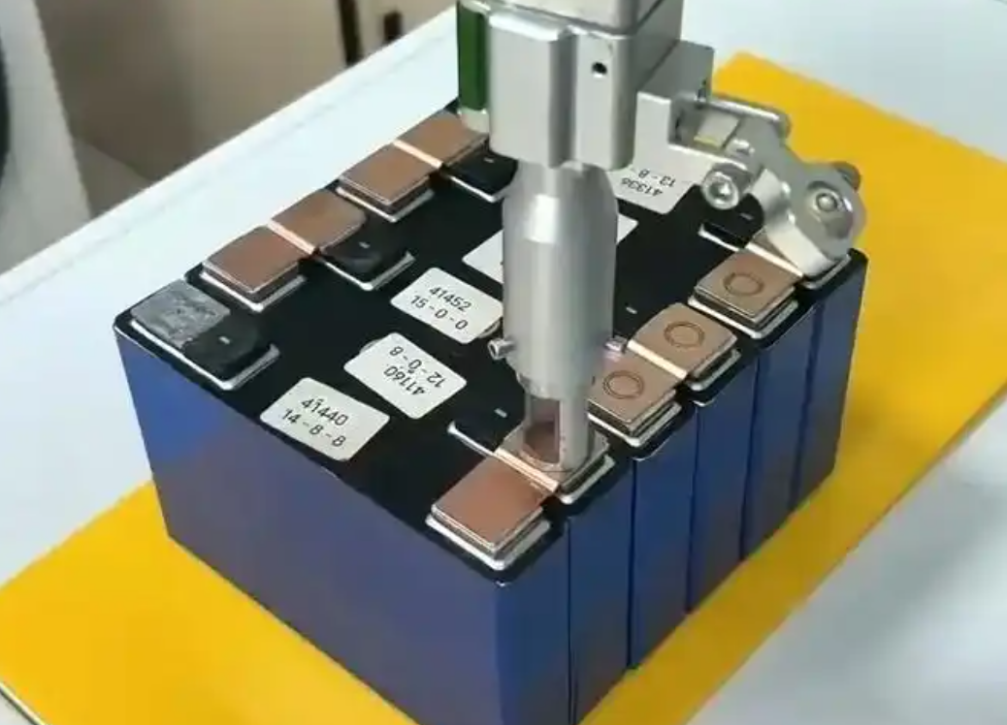
1. Electric Vehicle Battery Manufacturing:
Problem: Welding thin, highly conductive copper or aluminum busbars to battery cell tabs requires immense heat concentration to avoid damaging the heat-sensitive cell internals. Expulsion must be zero to prevent short circuits.
Solution: MFDC welders with adaptive control use very short, high-current pulses monitored by resistance feedback. The system stops the instant nugget formation is detected, creating a strong, minimal-heat weld. Servo guns ensure consistent, vibration-free electrode force. The result is high-strength electrical connections that preserve cell integrity and module safety.
2. Automotive Body-in-White (BiW):
Problem: Joining modern multi-material structures (e.g., aluminum doors to steel frames, or three sheets of UHSS) demands different energy profiles for each stack-up. Electrode wear on zinc coatings must be managed.
Solution: A single MFDC welding controller can store hundreds of weld schedules. For a mixed-material line, the robot simply calls the correct program. Adaptive control compensates for electrode wear and coating variance, extending tip life and maintaining nugget quality. The consistent DC output ensures symmetrical welds even in geometrically challenging locations.
3. Consumer Electronics and Microjoining:
Problem: Welding tiny components, like battery terminals in smartphones or wires in micro-motors, requires microscopic precision and minimal thermal distortion.
Solution: Precision MFDC or capacitor discharge (CD) spot welders deliver energy pulses as short as milliseconds. Force is measured in grams, and electrodes are precision-machined tungsten. Adaptive monitoring is critical here, as the margin for error is virtually zero. This enables reliable, automated assembly of miniature devices.
4.For R&D verification, low-volume pilot production, or field repair:KeyGree's pedal-operated and mini spot welder solutions deliver equally high-precision, low-thermal-impact welding.
Stainless Steel Pedal Control Spot Welding Machine
Keygree Group Co., Ltd.
Keygree Group Co., Ltd.
+86 18058395375
info@keygree.com
Legal Disclaimer:
EIN Presswire provides this news content "as is" without warranty of any kind. We do not accept any responsibility or liability for the accuracy, content, images, videos, licenses, completeness, legality, or reliability of the information contained in this article. If you have any complaints or copyright issues related to this article, kindly contact the author above.
